
The Massapequa School District has been involved in 8 voluntary lawsuits. Get to know them.
The Board’s Federal Mascot Case
Dismissed in Federal Court — March 27, 2025
-
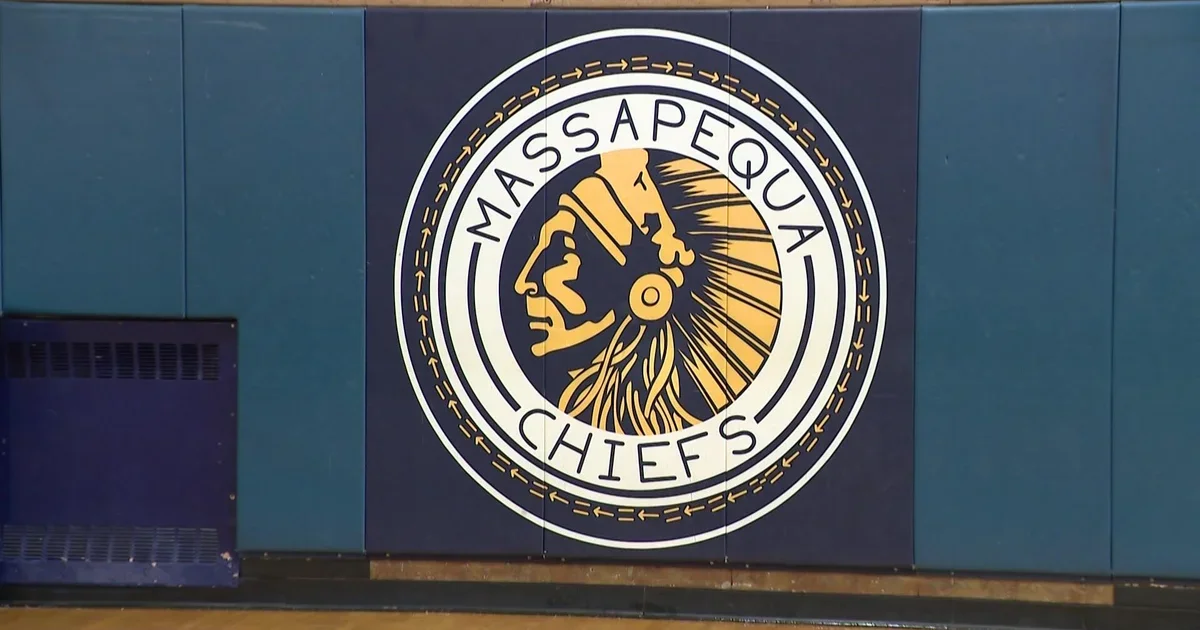
In 2001, the NYSDOE issued guidance encouraging districts to move away from native mascots, warning they reinforced stereotypes and conflicted with inclusive education. Over time, built on decades of research and civil rights law, the state concluded these mascots harm both Indigenous students—by marginalizing living cultures—and non-Indigenous students—by normalizing racialized imagery. The continued use of these mascots was deemed incompatible with the Dignity for All Students Act.
The mascot ban was formally enacted in June 2023, when the New York State Board of Regents adopted regulations requiring public schools to retire Native American mascots, with a multi-year transition period before enforcement.When New York State promulgated the policy, it was through a formal, multi-phase process designed to encourage dialogue and cooperation.
School districts were given two clear opportunities to engage with the state: first during the development and announcement of the policy, and later during a multi-year implementation period intended to help districts transition thoughtfully and responsibly.
The Massapequa BOE did not communicate with the state in any way during either phase. The district did not seek clarification, request an accommodation, or attempt to work with the state in any way.
The first contact the state received from Massapequa came not through educators or administrators, but through litigation counsel — after the district had already chosen to sue.
-
In its federal complaint, the board claimed that the mascot regulation:
Violated the First Amendment
Violated equal protection and due process rights
Caused reputational and operational harm to the district
Unlawfully interfered with local control of schools
The board asked the federal court to declare the regulation unconstitutional and to stop the state from enforcing it against Massapequa.
Notably, the plaintiffs in this case were:
The school district
The board of education
A board member acting in both her official capacity and as a parent
No students were named as plaintiffs.
-
The court did not rule on whether the mascot policy was constitutional. Instead, it found that the case failed at a more basic level.
In plain terms, the judge ruled that:
1. The district and board lacked legal capacity to sue the state
School districts are political subdivisions of New York State. As such, they generally cannot sue the state over how state education policy is set.
2. The plaintiffs failed to show harm
The court found that the lawsuit relied on speculative or generalized grievances—not specific, legally cognizable injuries.
Disagreement with state policy, the court explained, is not the same thing as legal harm.
3. Official-capacity claims did not create constitutional rights
A board member acting in her official role does not have personal constitutional rights against the state that created the office. For that, the board member would have to file as a private citizen.
Because of these defects, the court dismissed the case without reaching the constitutional arguments themselves.
-
At the time of dismissal, the board had several options:
Begin the waiver or transition process required by state law
End the litigation and redirect resources back to district priorities
Accept the court’s ruling and avoid further legal expense
The board chose none of these.
Instead, it doubled down—refiling and expanding its legal strategy in federal court, despite the judge having clearly identified the core defects in its case.
That decision set the stage for what came next:
a second federal dismissal, additional lawsuits, and escalating legal costs paid by Massapequa taxpayers.
The Amended Federal Mascot Lawsuit & the NAGA Case
Dismissed in Federal Court — November 14, 2025
-
After Massapequa’s initial lawsuit was dismissed, the Board brought in Oliver Roberts, a former Massapequa graduate, and by extension Holtzman Vogel Baran Torchinsky & Josefak, a large political affairs firm based in Washington, D.C. Rather than pursue administrative resolution, the district escalated the dispute.
Mr. Roberts wrote a letter to Linda McMahon asking the U.S. Department of Education to investigate New York State for civil rights violations, block the mascot policy, and withhold federal funding. The letter framed the policy as unconstitutional and urged the federal government to intervene directly in support of the district’s lawsuit.
At the same time, the district aligned itself with Native American Guardians Association (NAGA), a group out of North Dakota funded by donors like Dan Snyder, former owner of the Washington Redskins. NAGA later filed a lawsuit connected to Massapequa’s mascot. It’s important to note that local tribes, the Shinnecock and Unkechaug Nations, are opposed to Massapequa’s mascot.
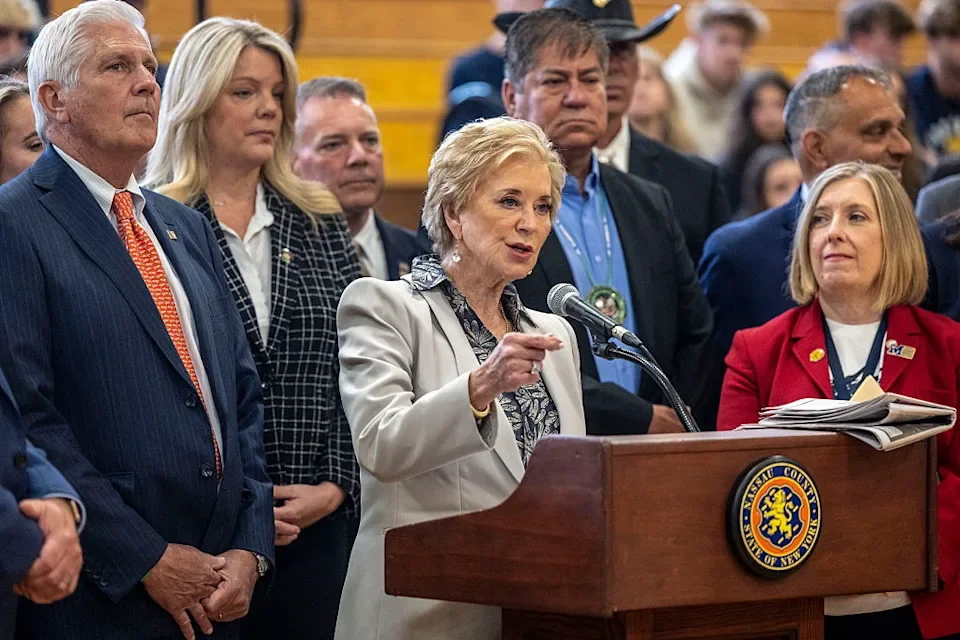
To announce the refiling of the lawsuit, the Board hosted a political rally on school grounds during school hours. Students attending gym class were directed to sit in the bleachers behind the podium. In his speech, NAGA representative Frank Black Cloud described the event as “MAGA meets NAGA.” Bruce Blakeman and Ms. McMahon attended and spoke at the event, and the latter was presented with a “Chiefs” sweatshirt bearing President Trump’s name.
Between the dismissal and refiling, board president Wachter appeared on Fox News three times.
In refiling the case, the district spent more than $50,000 on outside legal firms, in addition to its regular counsel.
-
The amended filing repeated the arguments from the original lawsuit. Additional context was added, but no new arguments or evidence.
The plaintiffs remained:
The Massapequa Union Free School District
The Board of Education
A board member also listed as a resident/parent
Despite the earlier dismissal, the board:
Did not change the core plaintiffs
Did not resolve the court’s concerns about capacity
Did not identify new, concrete harms
Instead, the amended complaint expanded its legal theories and doubled down on constitutional claims.
-
NAGA argued that:
It had entered into an agreement with the district “licensing” the mascot to them
The state regulation interfered with that agreement
The policy therefore caused legal harm to both NAGA and the district be creating a breach of contract
In effect, the NAGA case attempted to create standing by introducing a third-party organization into the dispute.
-
On November 14, 2025, Judge Sanket J. Bulsara dismissed both cases.
Like the first judge, he did not rule on if the policy was constitutional. Instead, he found the exact same legal deffects.
The court reaffirmed the earlier ruling against the Board, finding that:
The district and board still lacked capacity to sue the state
The amended complaint still failed to allege concrete, non-speculative harm
Changing lawyers and expanding legal arguments did not fix the core problem
The judge noted that these defects were not new—and had already been identified months earlier.
Regarding NAGA
The court also dismissed NAGA’s lawsuit, ruling that:
NAGA lacked standing
The alleged agreement with the district did not create enforceable legal injury
The claimed harms were indirect and speculative
In other words, adding an advocacy organization did not cure the standing problem.
The judge recognized that NAGA had been brought in as a “clever attempt” to solve Massapequa’s standing issues. He did not mean “clever” as a compliment.
Because the Board and their lawyers did not amend and refile in good faith, the judge denied them the ability to do so again.
-
After the November 14 dismissal:
The district court case was effectively over
The only remaining claims belonged to an individual plaintiff, who later voluntarily dismissed them
No federal court had found any plaintiff with standing to challenge the mascot regulation
Rather than ending the litigation at that point, the board chose to appeal.
On December 12, 2025, the district and board filed a notice of appeal to the U.S. Court of Appeals for the Second Circuit.
Notably:
The appeal again lists the Board and the district as plaintiffs. There is little reason to expect this case will be successful.
-
The school board has appealed this dismissal to the Second Circuit.
Nothing about the appeal fixes the problems that caused the case to be dismissed twice already:
The district still lacks the legal right to sue the state.
The board still cannot show concrete harm.
Federal appeals courts do not re-litigate facts or invent standing.
Two different federal judges have already rejected this case for the same reasons. An appeal does not change those reasons.
Public records show that the last round of filings — from dismissal to amended case — cost about $50,000 in legal fees.
It is reasonable to expect the appeal to cost another $50,000, with no refund if it fails.
If the appeal is dismissed and the board continues to ignore the mascot regulation, the state can move from court rulings to enforcement.
That could include withholding state funding.
At that point, the board will likely claim that this is the “harm” they were missing before, albeit self-inflicted — and use it as grounds to file yet another lawsuit.
Based on past behavior, that lawsuit could mean another bill of roughly $50,000, and more with appeals.
The pattern is clear:
File a lawsuit
Lose
Spend tens of thousands of dollars
File again
Nothing about the appeal suggests the cycle is ending. This appeal doesn’t solve the problem.
It delays it.And every delay costs the district more money — money that does not go to students, classrooms, or teachers.
The Board’s (2nd) Federal Mascot Case
Withdrawn — October 17, 2025
-
After Massapequa’s initial lawsuit was dismissed, the Board brought in Oliver Roberts, a former Massapequa graduate, and by extension Holtzman Vogel Baran Torchinsky & Josefak, a large political affairs firm based in Washington, D.C. Rather than pursue administrative resolution, the district escalated the dispute.
Mr. Roberts wrote a letter to Linda McMahon asking the U.S. Department of Education to investigate New York State for civil rights violations, block the mascot policy, and withhold federal funding. The letter framed the policy as unconstitutional and urged the federal government to intervene directly in support of the district’s lawsuit.
At the same time, the district aligned itself with Native American Guardians Association (NAGA), a group funded by donors like Dan Snyder, former owner of the Washington Redskins. NAGA later filed a lawsuit connected to Massapequa’s mascot.
To announce the refiling of the lawsuit, the Board hosted a political rally on school grounds during school hours. Students attending gym class were directed to sit in the bleachers behind the podium. In his speech, NAGA representative Frank Black Cloud described the event as “MAGA meets NAGA.” Bruce Blakeman and Ms. McMahon attended and spoke as well, and the latter was presented with a “Chiefs” sweatshirt bearing President Trump’s name.
Between the dismissal and refiling, board president Wachter appeared on Fox News three times.
In refiling the case, the district spent more than $50,000 on outside legal firms, in addition to its regular counsel.
-
The amended filing repeated the arguments from the original lawsuit. Additional context was added, but no new arguments or evidence.
The plaintiffs remained:
The Massapequa Union Free School District
The Board of Education
A board member also listed as a resident/parent
Despite the earlier dismissal, the board:
Did not change the core plaintiffs
Did not resolve the court’s concerns about capacity
Did not identify new, concrete harms
Instead, the amended complaint expanded its legal theories and doubled down on constitutional claims.
-
NAGA argued that:
It had entered into an agreement with the district “licensing” the mascot to them
The state regulation interfered with that agreement
The policy therefore caused legal harm to both NAGA and the district be creating a breach of contract
In effect, the NAGA case attempted to create standing by introducing a third-party organization into the dispute.
-
On November 14, 2025, Judge Sanket J. Bulsara dismissed both cases.
Like the first judge, he did not rule on if the policy was constitutional. Instead, he found the exact same legal deffects.
The court reaffirmed the earlier ruling against the Board, finding that:
The district and board still lacked capacity to sue the state
The amended complaint still failed to allege concrete, non-speculative harm
Changing lawyers and expanding legal arguments did not fix the core problem
The judge noted that these defects were not new—and had already been identified months earlier.
Regarding NAGA
The court also dismissed NAGA’s lawsuit, ruling that:
NAGA lacked standing
The alleged agreement with the district did not create enforceable legal injury
The claimed harms were indirect and speculative
In other words, adding an advocacy organization did not cure the standing problem.
The judge recognized that NAGA had been brought in as a “clever attempt” to solve Massapequa’s standing issues. He did not mean “clever” as a compliment.
Because the Board and their lawyers did not amend and refile in good faith, the judge denied them the ability to do so again.
-
After the November 14 dismissal:
The district court case was effectively over
The only remaining claims belonged to an individual plaintiff, who later voluntarily dismissed them
No federal court had found any plaintiff with standing to challenge the mascot regulation
Rather than ending the litigation at that point, the board chose to appeal.
On December 12, 2025, the district and board filed a notice of appeal to the U.S. Court of Appeals for the Second Circuit.
Notably:
The appeal again lists the Board and the district as plaintiffs. There is little reason to expect this case will be successful.
-
The school board has appealed this dismissal to the Second Circuit.
Nothing about the appeal fixes the problems that caused the case to be dismissed twice already:
The district still lacks the legal right to sue the state.
The board still cannot show concrete harm.
Federal appeals courts do not re-litigate facts or invent standing.
Two different federal judges have already rejected this case for the same reasons. An appeal does not change those reasons.
Public records show that the last round of filings — from dismissal to amended case — cost about $50,000 in legal fees.
It is reasonable to expect the appeal to cost another $50,000, with no refund if it fails.
If the appeal is dismissed and the board continues to ignore the mascot regulation, the state can move from court rulings to enforcement.
That could include withholding state funding.
At that point, the board will likely claim that this is the “harm” they were missing before, albeit self-inflicted — and use it as grounds to file yet another lawsuit.
Based on past behavior, that lawsuit could mean another bill of roughly $50,000, and more with appeals.
The pattern is clear:
File a lawsuit
Lose
Spend tens of thousands of dollars
File again
Nothing about the appeal suggests the cycle is ending. This appeal doesn’t solve the problem.
It delays it.And every delay costs the district more money — money that does not go to students, classrooms, or teachers.
The State Court Mascot Lawsuit
Filed September 2025
-
After losing twice in federal court, the school board changed venues.
In September 2025, the board filed a new lawsuit in New York State Supreme Court (Albany County). This case does not directly ask the court to strike down the mascot regulation. Instead, it challenges the state’s refusal to give Massapequa more time to comply with it.
Rather than narrowing the dispute, the board expanded it.
This lawsuit names:
The Massapequa Union Free School District
The Board of Education
Two board members, both as officials and as parents
A parent filing on behalf of herself and her child
The Save the Chiefs Foundation
The Native American Guardians Association
It also names multiple state officials and agencies as respondents.
-
In this case, the board argues that the state acted unfairly by denying Massapequa an extension of time to comply with the mascot regulation.
Specifically, the board claims that:
Other Long Island districts were granted extensions
Massapequa was treated differently
Federal Title VI developments created legal uncertainty
Immediate compliance would cause financial and legal harm
The board is asking the state court to:
Extend the compliance deadline, or
Pause enforcement of the regulation while litigation continues
In short, this lawsuit is an attempt to delay compliance, not resolve the underlying issue.
-
On November 14, 2025, Judge Sanket J. Bulsara dismissed both cases.
Like the first judge, he did not rule on whether the mascot policy was wise or fair. Instead, he focused on threshold legal defects.
Regarding the school board
The court reaffirmed the earlier ruling, finding that:
The district and board still lacked capacity to sue the state
The amended complaint still failed to allege concrete, non-speculative harm
Changing lawyers and expanding legal arguments did not fix the core problem
The judge noted that these defects were not new—and had already been identified months earlier.
Regarding NAGA
The court also dismissed NAGA’s lawsuit, ruling that:
NAGA lacked standing
The alleged agreement with the district did not create enforceable legal injury
The claimed harms were indirect and speculative
In other words, adding an advocacy organization did not cure the standing problem.
-
After the November 14 dismissal:
The district court case was effectively over
The only remaining claims belonged to an individual plaintiff, who later voluntarily dismissed them
No federal court had found any plaintiff with standing to challenge the mascot regulation
Rather than ending the litigation at that point, the board chose to appeal.
On December 12, 2025, the district and board filed a notice of appeal to the U.S. Court of Appeals for the Second Circuit.
Notably:
The appeal dropped claims that a board member acting in her official capacity had constitutional rights
The only individual listed is now identified solely as a resident/parent
The appeal challenges the dismissal and the court’s refusal to allow further amendments
-
The school board has appealed this dismissal to the Second Circuit.
Nothing about the appeal fixes the problems that caused the case to be dismissed twice already:
The district still lacks the legal right to sue the state.
The board still cannot show concrete harm.
Federal appeals courts do not re-litigate facts or invent standing.
Two different federal judges have already rejected this case for the same reasons. An appeal does not change those reasons.
Public records show that the last round of filings — from dismissal to amended case — cost about $50,000 in legal fees.
It is reasonable to expect the appeal to cost another $50,000, with no refund if it fails.
If the appeal is dismissed and the board continues to ignore the mascot regulation, the state can move from court rulings to enforcement.
That could include withholding state funding.
At that point, the board will likely claim that this is the “harm” they were missing before, albeit self-inflicted — and use it as grounds to file yet another lawsuit.
Based on past behavior, that lawsuit could mean another bill of roughly $50,000, and more with appeals.
The pattern is clear:
File a lawsuit
Lose
Spend tens of thousands of dollars
File again
Nothing about the appeal suggests the cycle is ending. This appeal doesn’t solve the problem.
It delays it.And every delay costs the district more money — money that does not go to students, classrooms, or teachers.