
A pattern of incompetence:
Why the School Board’s lawsuits always fail.
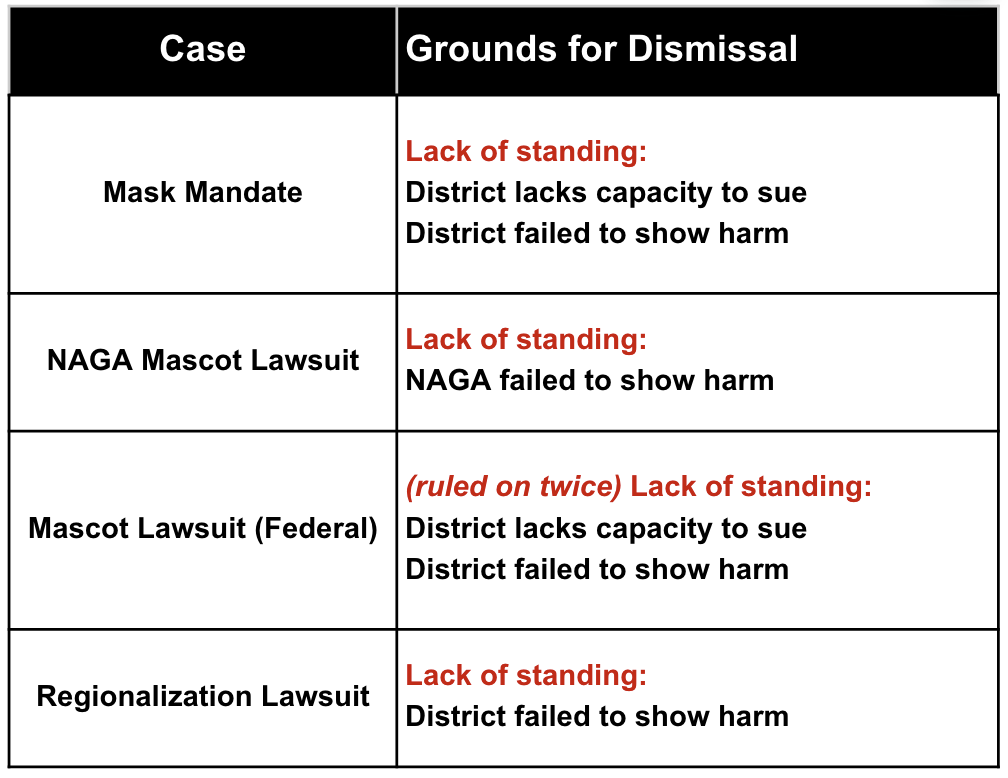
The Massapequa School Board has been involved in 8 voluntary lawsuits since 2020.
They have won zero of them.
A voluntary lawsuit is one in which the district is a plaintiff – meaning they are suing, and are not being sued – and there is no legal basis compelling them to file a lawsuit.
A Breakdown of The Massapequa BOE Voluntary Lawsuits:
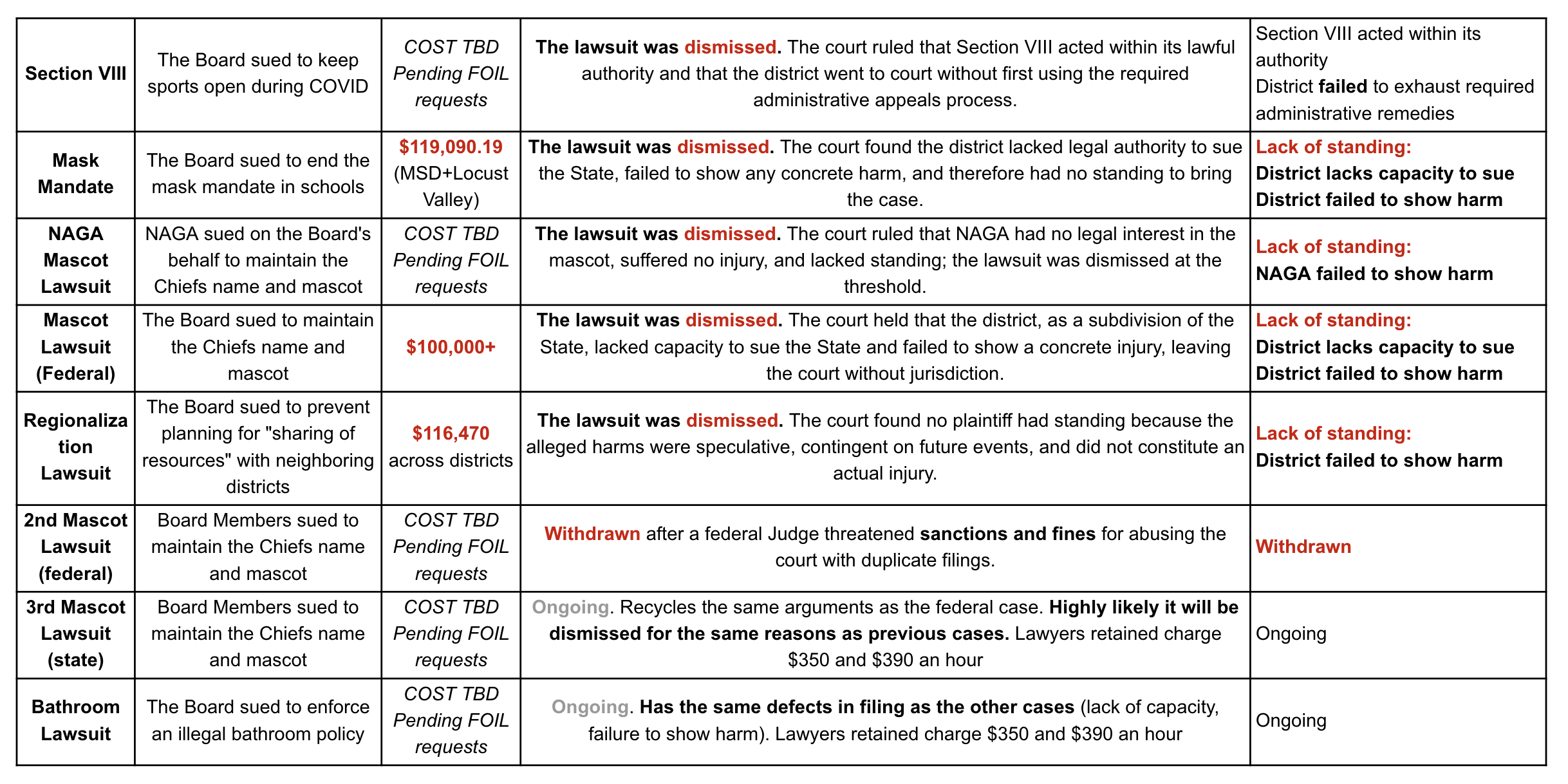
Let’s focus on these lawsuits and their lack of standing.
What is
lack of standing?
For a lawsuit to be considered, the parties must have capacity and must demonstrate harm.
Capacity: Does the party have the authority to bring the lawsuit?
Harm: Can the party point to specific personal injury or harm that could be fixed by a court ruling?
Specific: Has to be a noted instance. Not general “harm”.
Personal: Has to have happened to the filing party, not on someone else’s behalf.
Fixed: Has to be something the court could repair with an order.
When the MSD school board filed the Mask Mandate lawsuit in 2021, it didn’t make much sense.
There was another, stronger lawsuit moving through the courts set to achieve the same goal of ending the mask mandate. Legal experts predicted Massapequa’s case would be dismissed on the grounds that the state was acting well within its legal authority, but the actual ruling taught The Board and their legal team something very important:
Lawsuits filed by the board against the state lack capacity because the state cannot sue itself.
Here is what the judge said in his ruling:
“Municipal entities — counties, towns and school districts — do not have the inherent power to sue the State itself.”
- Hon. Henry F. Zwack, presiding judge on the Mask Mandate Lawsuit
Who is considered “the state”?
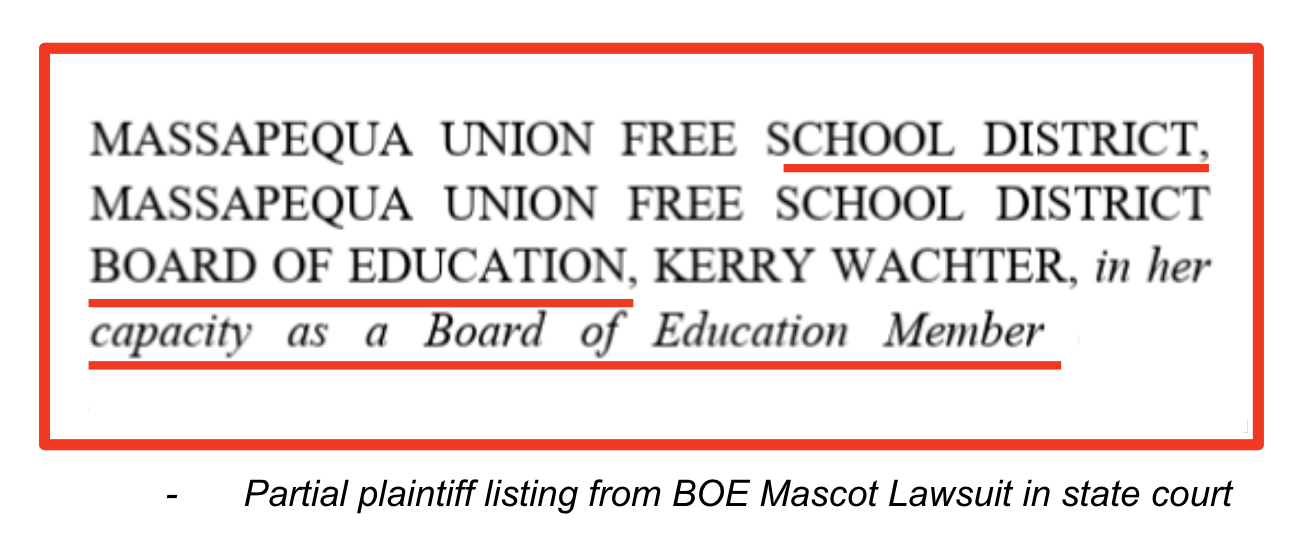
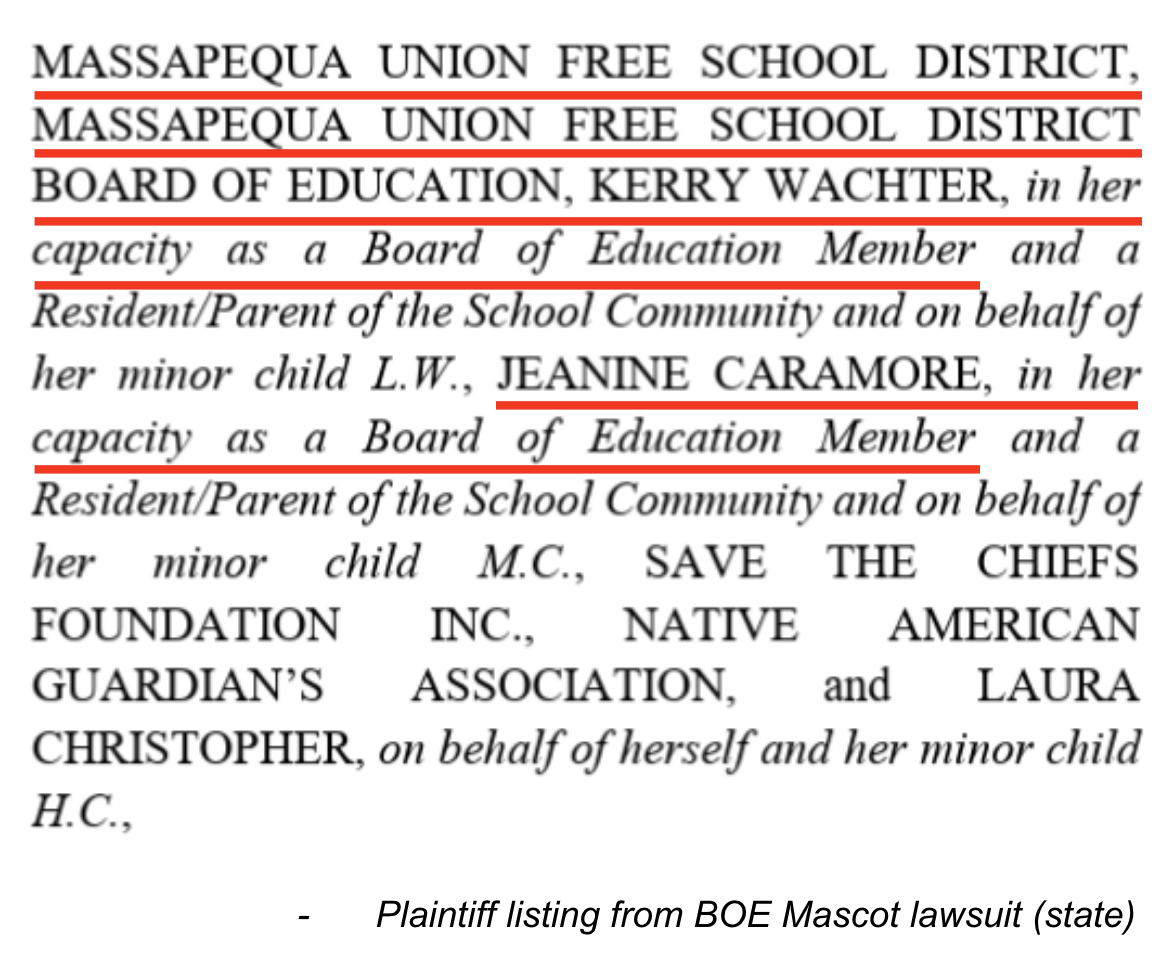
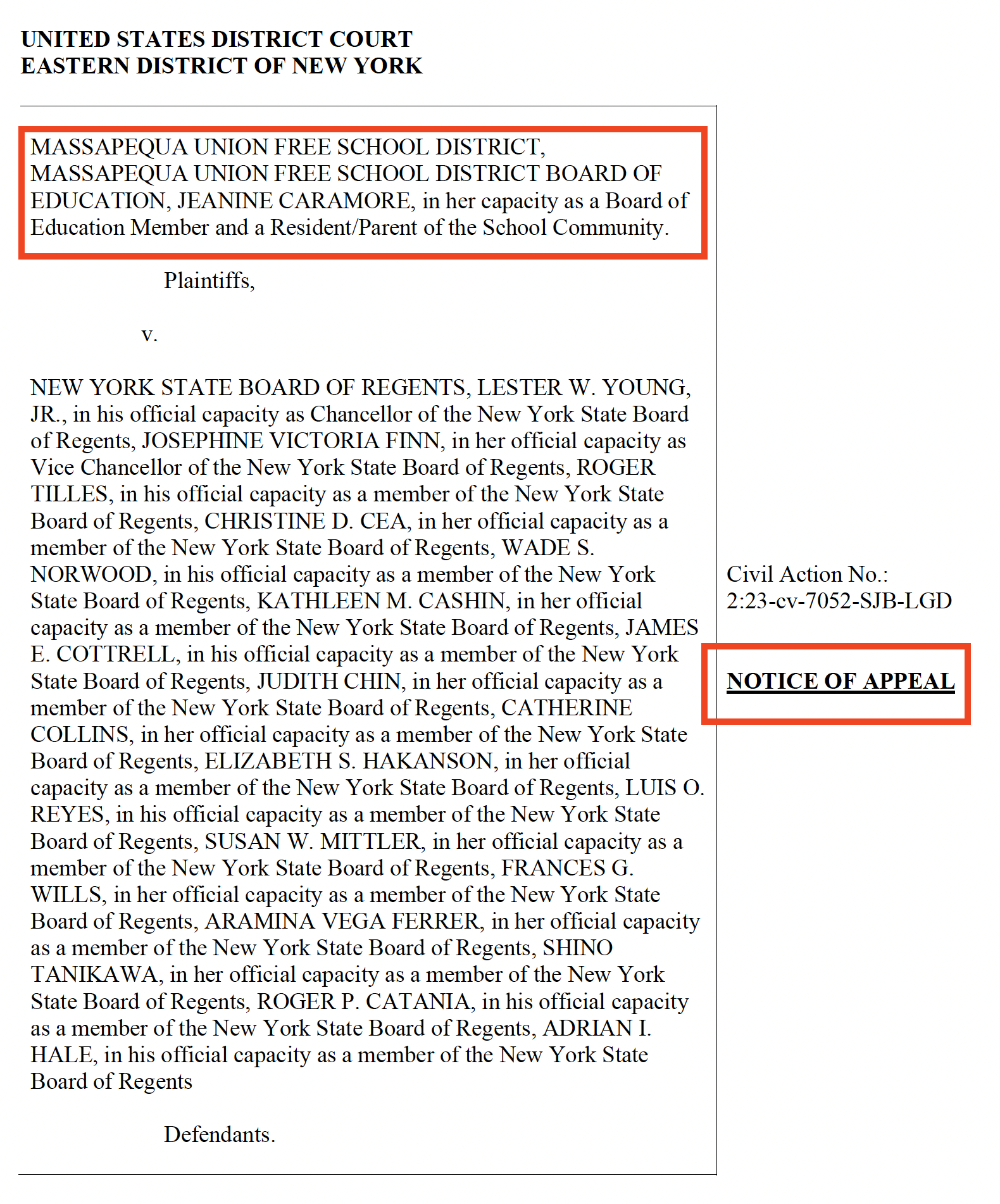
If plaintiffs include “SCHOOL DISTRICT”, “BOARD OF EDUCATION”, or an individual listed as “in their capacity as a Board Member”, they are considered acting as “the state” and DO NOT have capacity to bring the lawsuit.

If defendants include NYS governing bodies (department of education, board of regents, etc), or individuals “in their official capacity” (Governor Hochul, Ed. Commissioner Betty Rosa, etc) they are acting as “the state” and CANNOT be sued by “the state”.
But that’s not the only reason the Mask Mandate case was dismissed. The judge also addressed harm:
“Petitioners have likewise failed to establish injury in fact, which would have given them standing if they had capacity to sue in the first instance.”
This means as of 2021 the Massapequa BOE knows they must have capacity and demonstrate harm for a lawsuit to be successful.
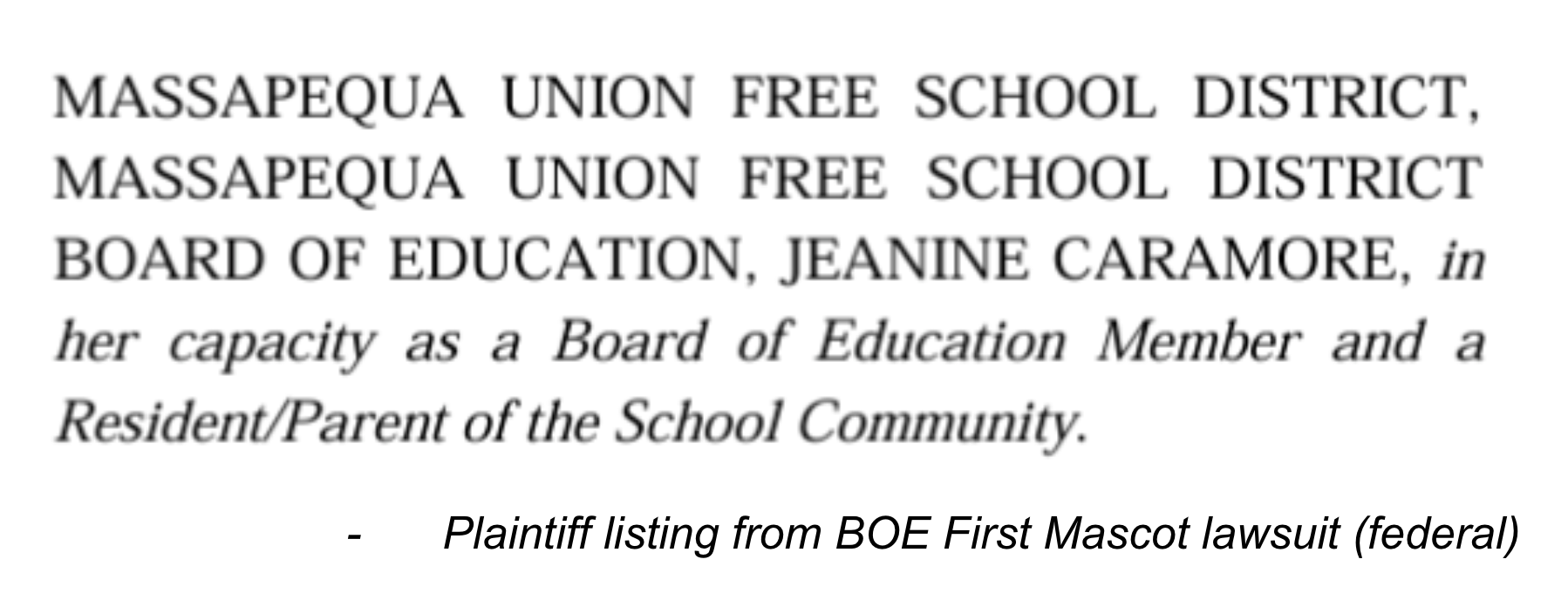
But when the Massapequa School District brought the first Mascot lawsuit, they still listed the school district, board of education, and an individual in their official capacity.
In March of 2025, the Mascot lawsuit was dismissed for the exact same reason as the Mask Mandate lawsuit.
Here is what the judge said in her ruling:
“Municipalities and other local governmental corporate entities and their officers lack capacity to mount constitutional challenges to acts of the State and State legislation.”
“This rule is well-established and long-standing.”
“Because Plaintiffs lack capacity to sue, this Court lacks jurisdiction to hear their claims.”
- Judge Margo K. Brodie, presiding judge on the 1st Mascot Lawsuit
Additionally, the judge weighed in on the board’s failure to show harm.
“Plaintiffs’ assertions regarding potential enforcement consequences are speculative and insufficient to establish injury in fact.”
“...Plaintiffs have failed to demonstrate irreparable harm…”
- Judge Margo K. Brodie, presiding judge on the 1st Mascot Lawsuit
Judge Brodie allowed the district to amend their complaint to fix
“the defects”.
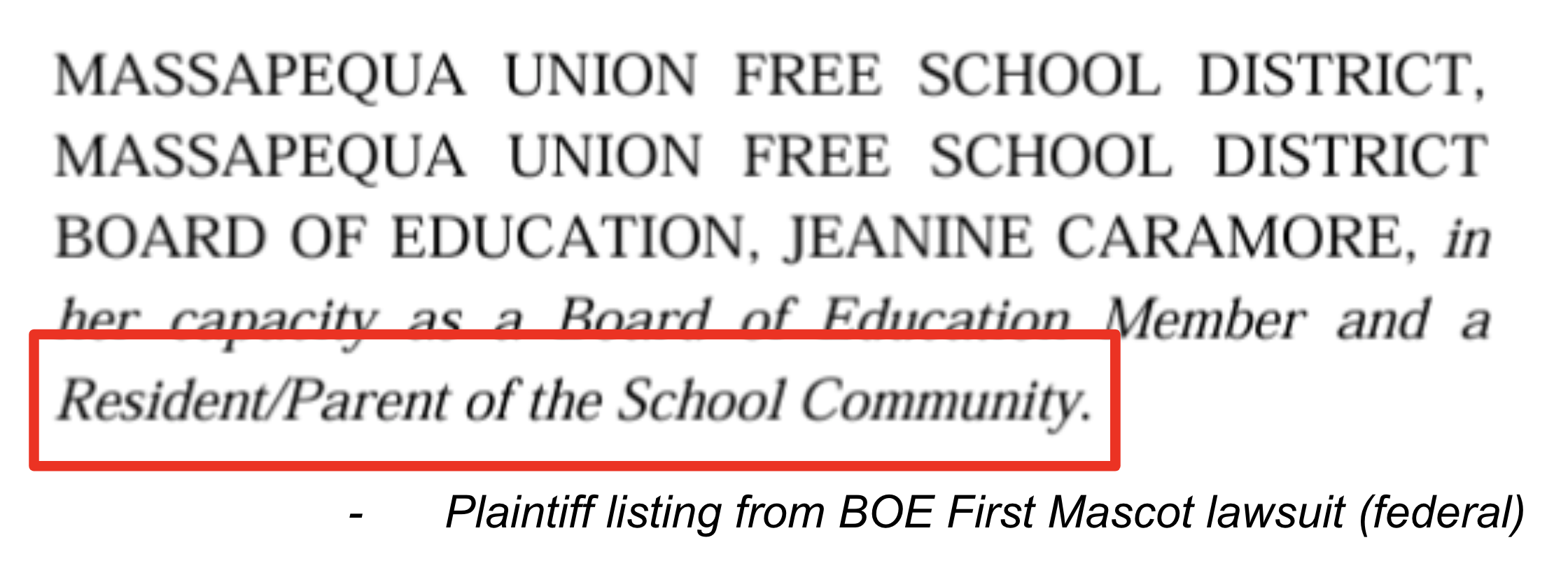
The Board could have removed the district, board, and official members to allow Ms. Caramore’s claims to proceed in her capacity as a “resident/parent”. The judge had ruled this was a viable case.
Instead, the board kept the same plaintiffs brought in the Native American Guardians Association (NAGA) to file another lawsuit on the board’s behalf, and signed a “contract” where NAGA “licensed” the mascot to Massapequa.
In November of 2025, a second judge dismissed the mascot lawsuit again for the exact same reasons.
“…they have recycled their prior allegations almost word for word and added a host of new claims that resemble constitutional word salad.”
"Municipal corporate bodies—counties, towns and school districts—are merely subdivisions of the State … and so for either to sue New York State is akin to a party suing itself."
"Massapequa and its Board, having had multiple attempts to file a complaint that survives dismissal, are denied further leave to amend."
- Judge Sanket J. Bulsara, presiding judge on NAGA and 1st Mascot Lawsuit
NAGA’s lawsuit was also dismissed.
The board and NAGA’s “contract” was a legal maneuver. The thought was by banning the mascot, the district would be “forced” to “breach” their contract and cause “injury” to NAGA. It was an attempt to manufacture harm, and Judge Sanket recognized it as such.
Here is what the judge said in his ruling:
“NAGA’s entry onto the scene was a clever attempt to cure Massapequa’s standing problems and its inability to sue the State of New York.”
“NAGA does not own the Chiefs name, logo, or imagery, nor does it control Massapequa’s use of them [...] It is a contract in name only.”
- Judge Sanket J. Bulsara, presiding judge on NAGA and 1st Mascot Lawsuit
In January of 2025, Massapequa led a multi-district lawsuit against the state over regionalization planning.
The case was dismissed on lack of standing because the Board could not demonstrate harm.
Here is what the judge said in his ruling:
“The Court finds that none of the petitioners have standing in any form to bring the instant proceeding.”
“The claimed ‘injury in fact’ is wholly speculative and ephemeral.”
“The petition/complaint is hereby dismissed in its entirety and the relief requested therein is in all respects denied.”
- Hon. Roger D. McDonough, presiding judge on regionalization lawsuit
The board and their lawyers know they have lack of standing, and yet they continue to file lawsuits the same way.
Why?
Claim’s brought by the board-
have no standing.
are not viable.
are paid for with tax dollars.
Claim’s brought by individuals-
can have standing–
if harm can be demonstrated.
are potentially viable.
must be privately funded.
Board members and community members who could have standing do not file lawsuits. Those lawsuits would be paid out of pocket.
The Board only pursues lawsuits that are not viable, but are paid for with public funds.
Which brings us to the current suits.
The Board has
three active voluntary lawsuits.
A state mascot lawsuit, a bathroom policy lawsuit, and most recently they have moved to appeal their first, twice failed, federal mascot lawsuit.
By looking at the cases
we can predict the outcomes.
The Bathroom Policy Lawsuit:
The Board has filed as “the State” and is suing “the State”. This will likely be dismissed for lack of capacity.
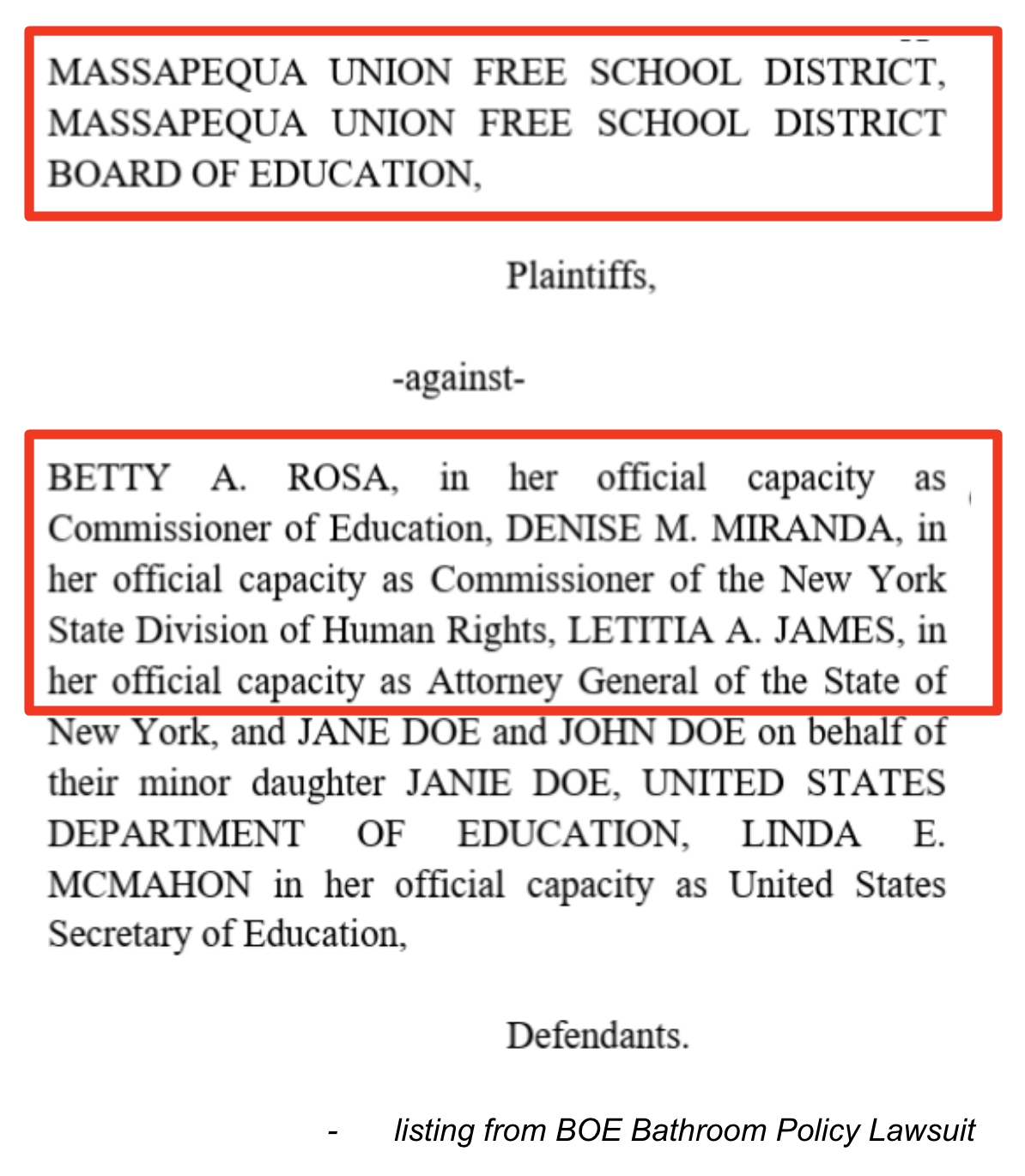
Additionally the school district and board have no demonstrable harm.
The State Mascot Lawsuit:
Once again The Board has filed in their official capacity but have not changed the substance of their arguments. This will likely be dismissed for lack of capacity.
The Federal Mascot Lawsuit (appeal):
When the board’s lawsuit was dismissed in November 2025, one claim remained: Ms. Caramore’s, as a private citizen.
Rather than pursue that viable claim, which can not be paid for by tax dollars the Board has closed out this case…
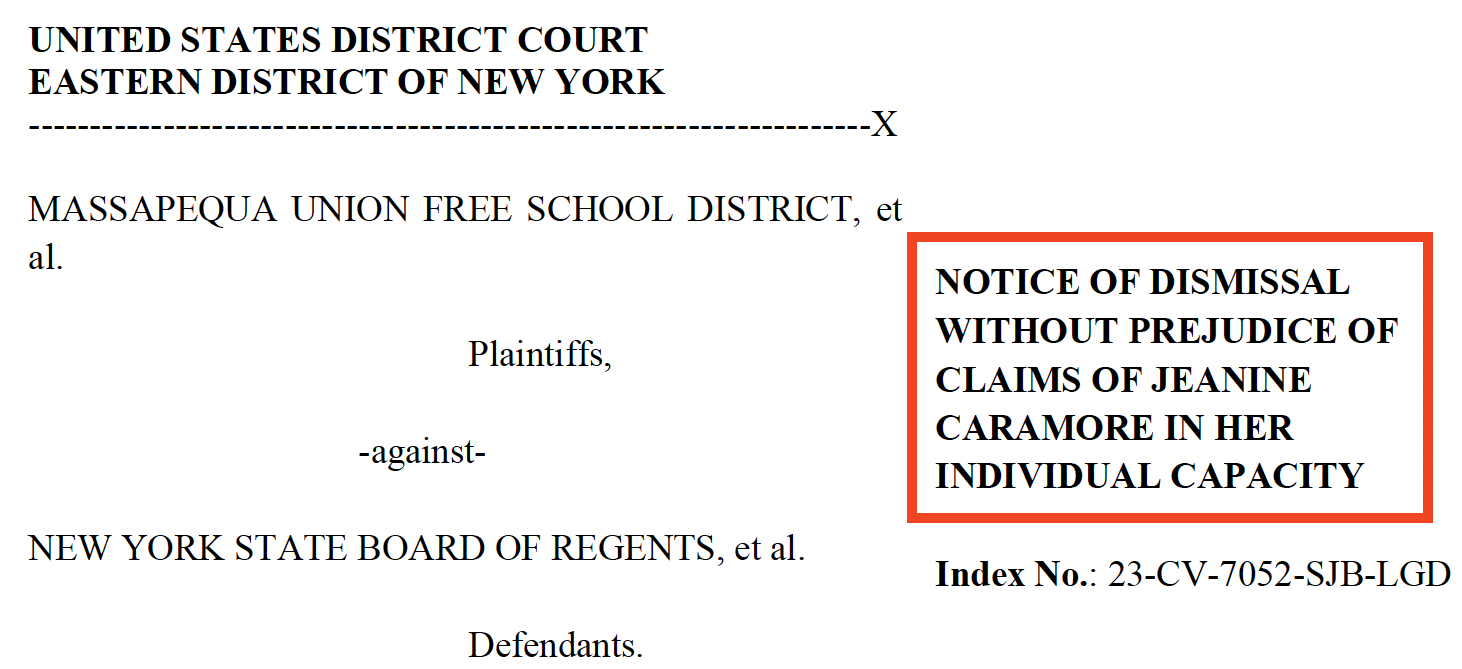
…and has appealed as a district, again, in spite of the knowledge that the case will not be heard because The Board and district are listed as defendants.
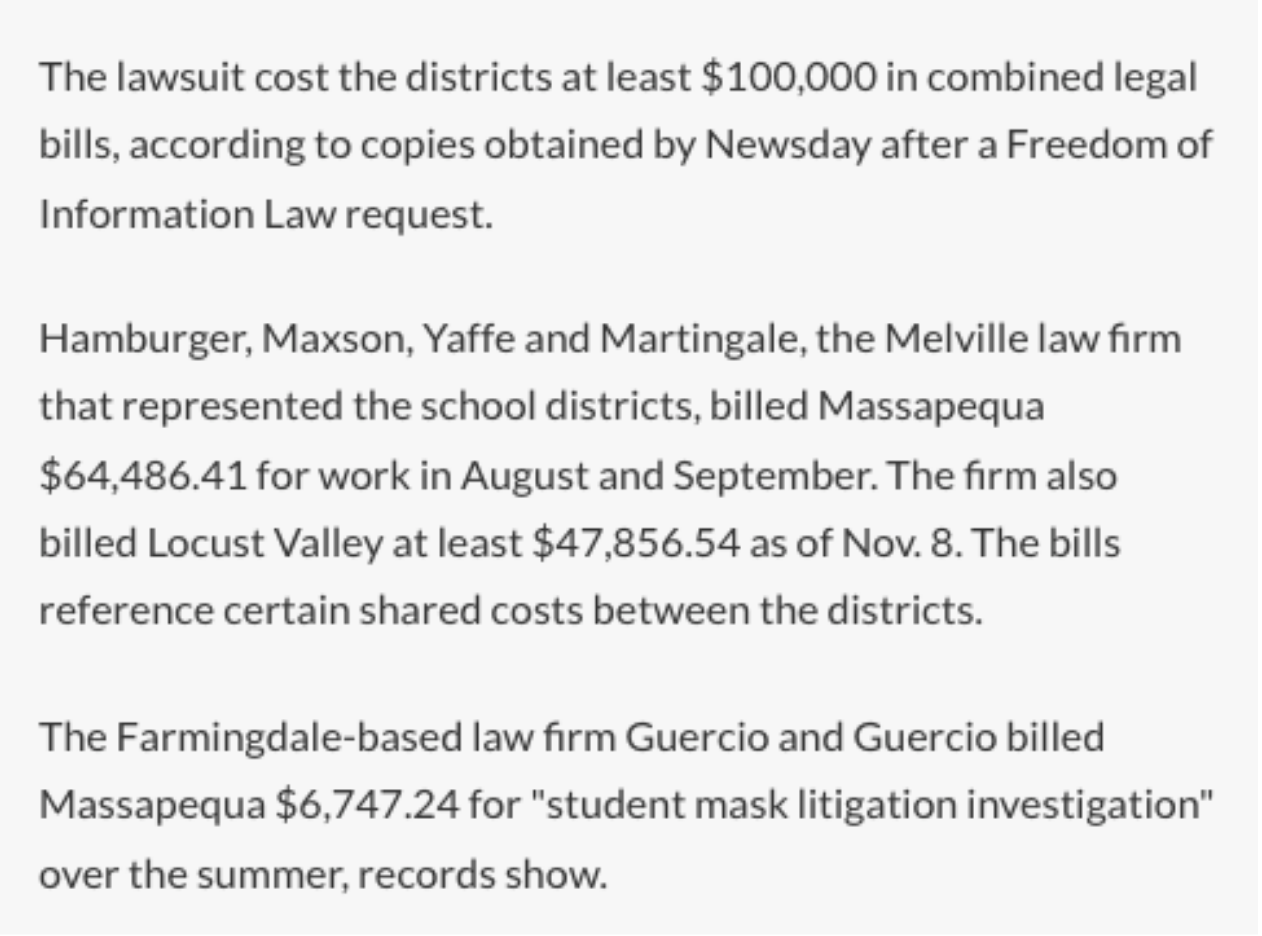
How much has this cost?
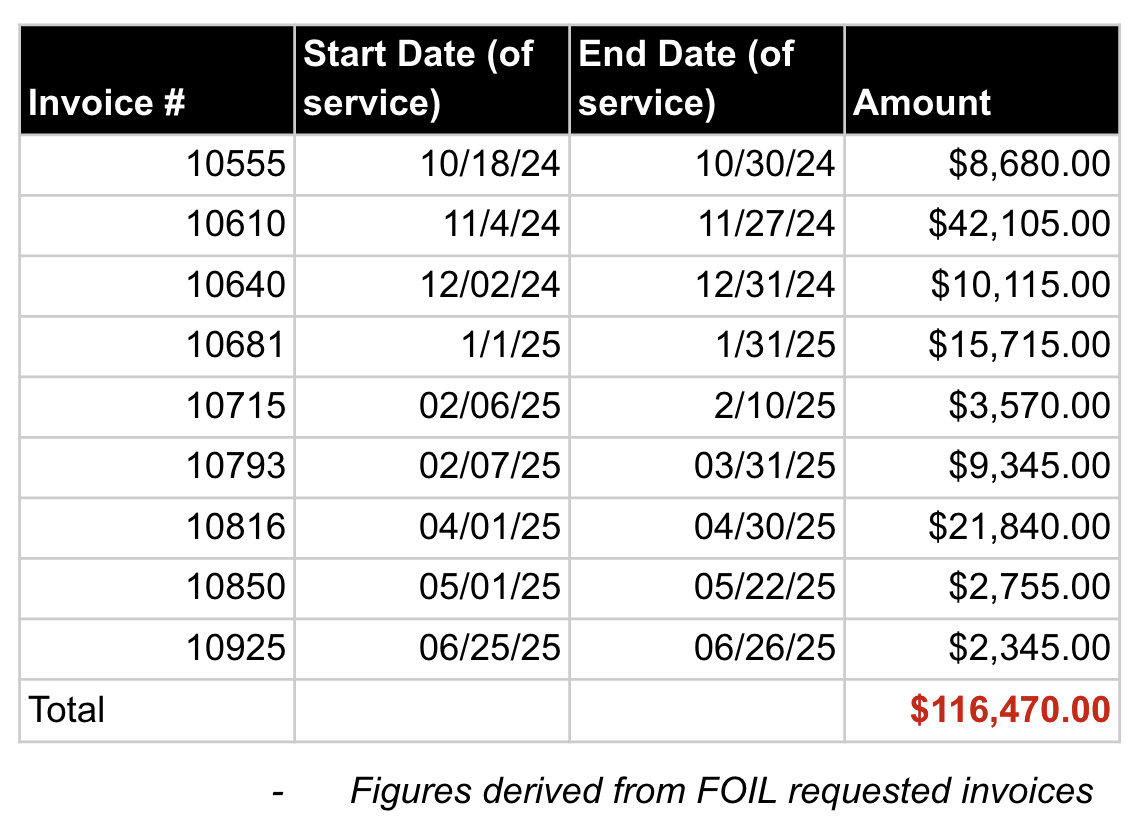
Spread across school districts, the total cost of the regionalization lawsuit was $116,470.00.
The district has spent $101,510 on Mascot lawsuits from 2023 through 2025.
The district spent $52,897.50 between March and July of this year alone.
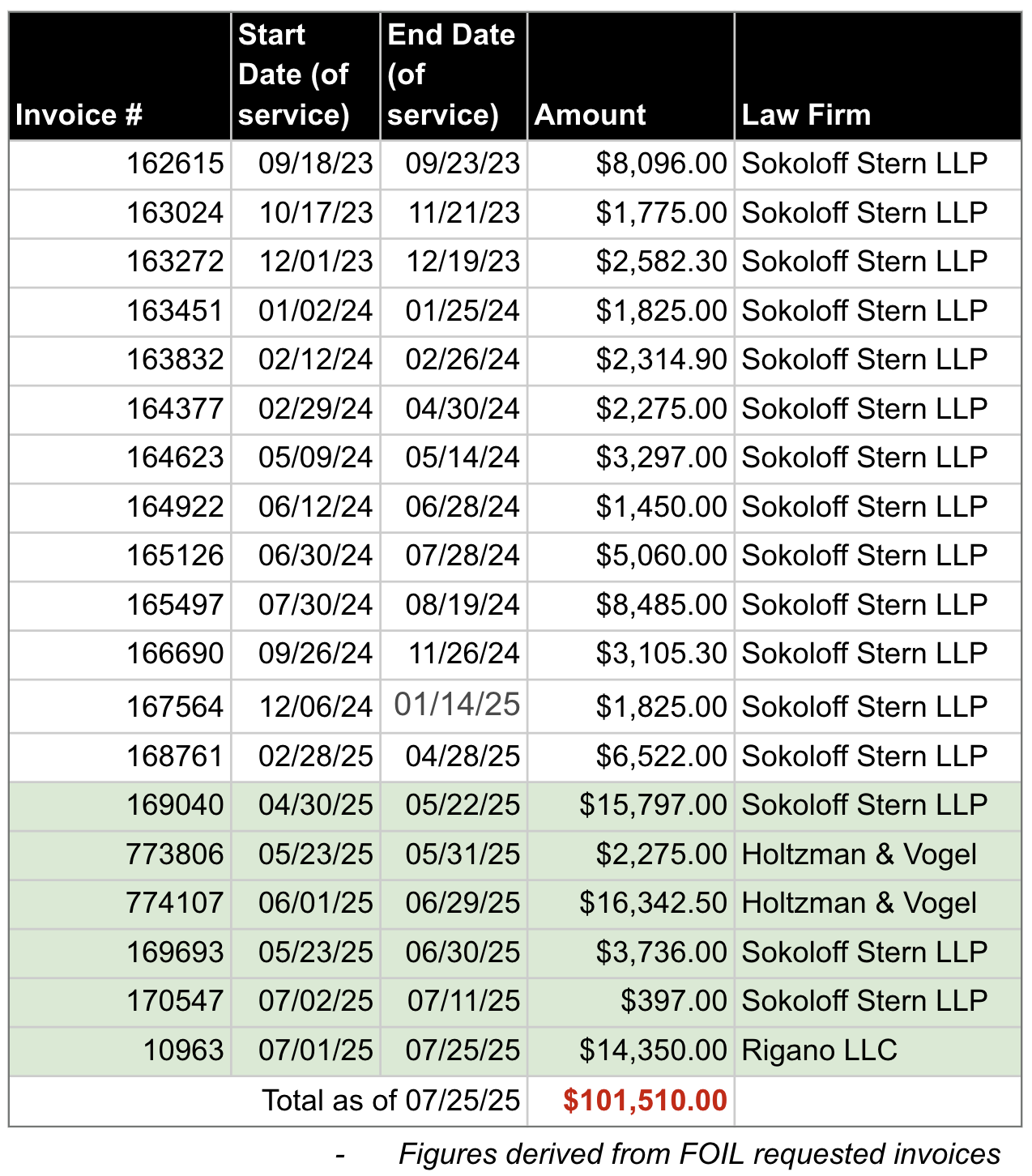
There are more billings unaccounted for from July through today, and with the district’s ongoing state lawsuit and their impending appeal in federal court, these costs will continue to rise.
There are thousands of dollars unaccounted for across lawsuits as we await more FOIL (Freedom of Information Law) requests, and as the district awaits more invoices from their law firms.
The Massapequa BOE has paid billings to four different law firms in 2025 alone.
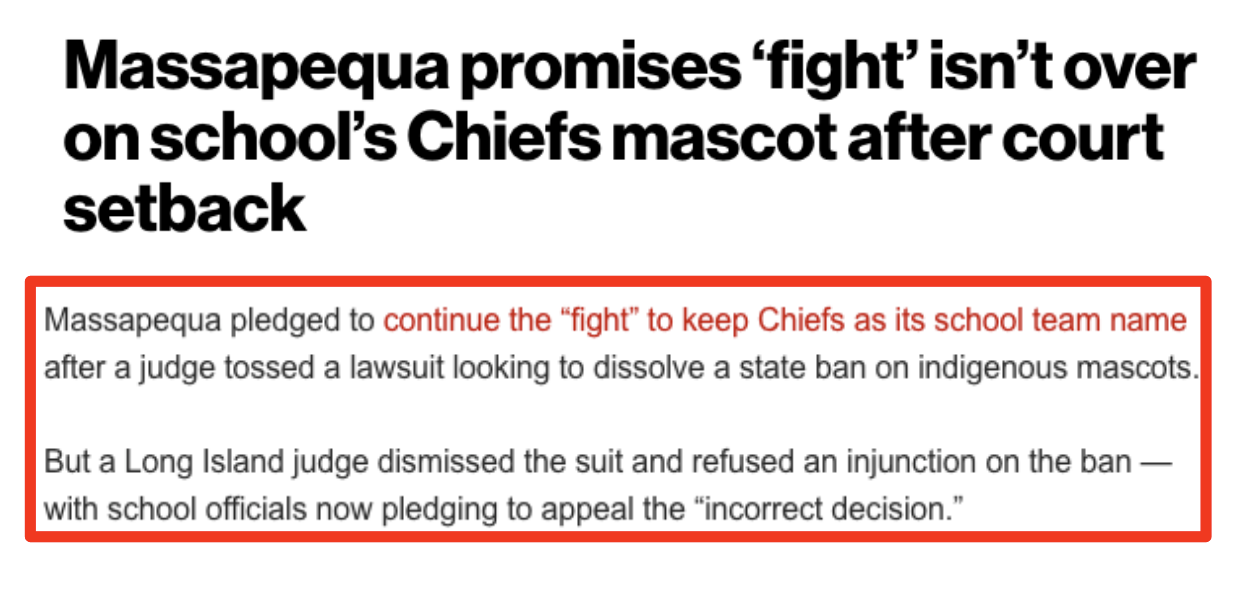
All five members of the board have vowed to continue filing doomed lawsuits paid for with taxpayer dollars.
- NY Post
With 8 lawsuits and zero wins, only two conclusions can be drawn: Either the board and their lawyers are incompetent or they do not intend to win these lawsuits.
If they do not intend to win the lawsuits, why file them? How do these lawsuits benefit Massapequa student’s education? The lawsuits generate headlines and create the illusion of “fighting” for the people of Massapequa, but the end result is wasted taxpayer dollars, jeopardized state funding, and fostered mistrust of both our legal and education system. In this way the result of the lawsuits do not matter to this board. A lawsuit is filed: there are headlines. A lawsuit is dismissed and the district gets to point fingers at Albany, play politics, and create more outrage when the suits they’ve filed had no merit in the first place. School districts have other tools available to them. They can advocate, mediate, and work with the department of education and the New York State School Board Association to meet their needs. They can work in partnership with the state and other districts. They can take part in the hard work of mediation and compromise for the benefit of our students.