
The Massapequa School District has been involved in 8 voluntary lawsuits. Get to
know them. Every court decision and legal invoice behind these cases is posted on the Source Documents page.
The Board’s Federal Mascot Case
Dismissed in Federal Court — March 27, 2025
-
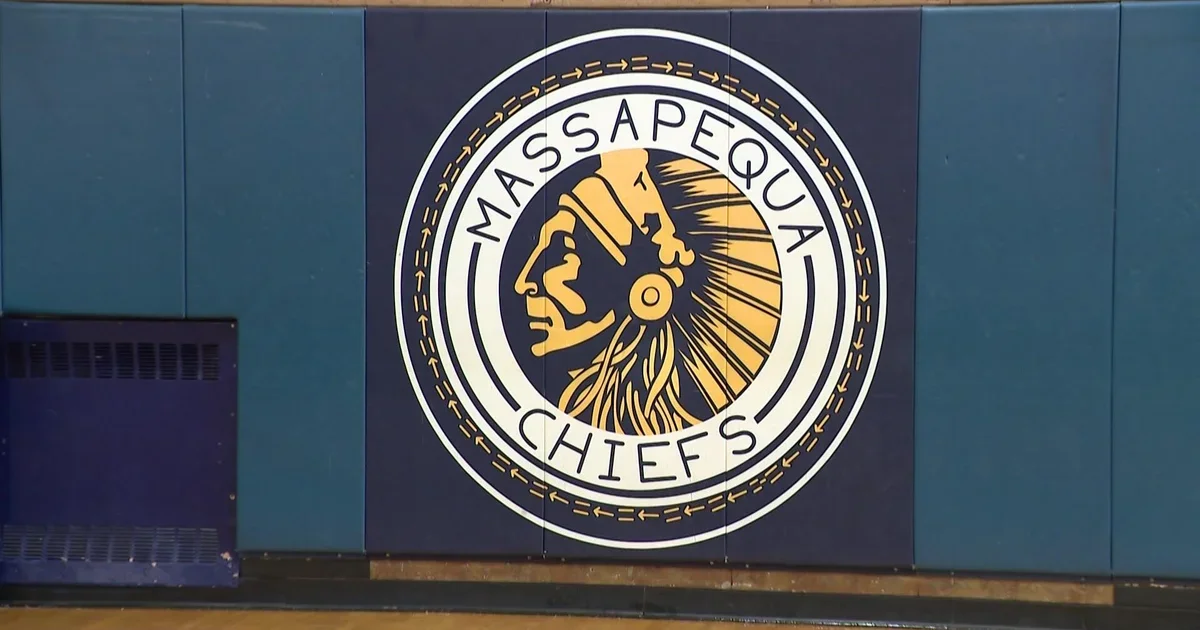
In 2001, the State Education Department told districts to move away from Native American mascots. The state said the mascots reinforced stereotypes. It said they conflicted with inclusive education.
The state kept studying the issue. It relied on decades of research and civil rights law. It concluded the mascots cause harm. They marginalize Indigenous students and their living cultures. They teach non-Indigenous students to accept racial stereotypes. The state said keeping the mascots violated the Dignity for All Students Act.
In June 2023, the Board of Regents made it a rule. Every public school had to retire its Native American mascot. Districts got several years to make the change before enforcement.
The state built this rule in stages, in public, and asked districts to take part. Districts had two chances to engage: while the policy was being developed and announced, and again during the multi-year transition period.
Massapequa's board never contacted the state. Not in either phase. It never asked a question. It never asked for an exception. It never tried to work with the state at all. The first time the state heard from Massapequa was from its lawyers — after the board had already decided to sue.
-
In its federal complaint, the board claimed that the mascot regulation:
Violated the First Amendment
Violated equal protection and due process rights
Caused reputational and operational harm to the district
Unlawfully interfered with local control of schools
The board asked the federal court to declare the regulation unconstitutional and to stop the state from enforcing it against Massapequa.
Notably, the plaintiffs in this case were:
The school district
The board of education
A board member acting in both her official capacity and as a parent
No students were named as plaintiffs.
-
The judge never ruled on whether the mascot policy was constitutional. The case failed on something more basic.
The judge ruled that:
1. School boards can't sue the state.
A school district is not independent of the state. The state creates school districts, and the state sets education policy. A district can't turn around and sue the state for making that policy.
2. The board couldn't prove anyone was harmed.
The lawsuit rested on guesses and general complaints. It never showed a specific, real injury — the kind of harm a court can act on. Disagreeing with state policy is not the same thing as being harmed by it.
3. Board members can't sue in their official capacity.
She sued as a board member. In that role, she has no personal constitutional rights against the state. Her rights exist only as an individual. And a suit brought as an individual would be hers to pay for — out of her own pocket, not with tax dollars.
With those problems, the judge dismissed the case. The court never reached the constitutional arguments at all.
-
After the dismissal, the next steps were clear. The board should have:
Begin the waiver or transition process required by state law
End the litigation and redirect resources back to district priorities
Accept the court's ruling and avoid further legal expense
The board did none of it.
Instead, it doubled down — refiling and expanding its legal strategy in federal court, despite the judge having clearly identified the core defects in its case.
That decision set the stage for what came next: a second federal dismissal, additional lawsuits, and escalating legal costs paid by Massapequa taxpayers.
The Amended Federal Mascot Lawsuit & the NAGA Case
Dismissed in Federal Court — November 14, 2025
-
1. After the March dismissal, Massapequa didn't engage the state. It escalated — bringing in Oliver Roberts and Holtzman Vogel, a Washington political-law firm.
2. Roberts wrote to Education Secretary Linda McMahon, asking the federal government to investigate New York, block the mascot policy, and withhold funding.
3. The district aligned itself with NAGA, a North Dakota group funded by Dan Snyder, the former Washington Redskins owner — while the local Shinnecock and Unkechaug Nations oppose the mascot.
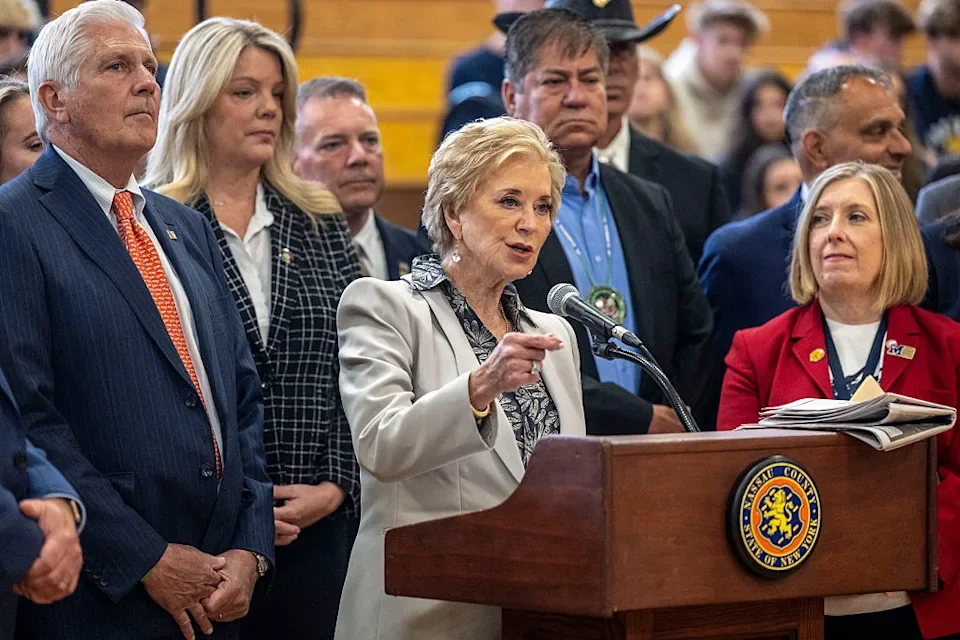
4. To announce the refiling, the board held a political rally on school grounds during school hours. Students in gym class were directed to sit in the bleachers behind the podium. Blakeman and McMahon spoke; NAGA's Frank Black Cloud called it "MAGA meets NAGA."
5. Every other district moved forward with an implementation plan — even the ones still pursuing legal action. Massapequa refiled. In 8 months, the district paid outside law firms $120,457 on the case — more than 3x what it had spent in the two years prior.
-
The amended filing repeated the arguments from the original lawsuit. Additional context was added, but no new arguments or evidence.
The plaintiffs remained:
The Massapequa Union Free School District
The Board of Education
A board member also listed as a resident/parent
Despite the earlier dismissal, the board:
Did not change the core plaintiffs
Did not resolve the court’s concerns about capacity
Did not identify new, concrete harms
Instead, the amended complaint expanded its legal theories and doubled down on constitutional claims.
-
NAGA argued that:
It had entered into an agreement with the district “licensing” the mascot to them
The state regulation interfered with that agreement
The policy therefore caused legal harm to both NAGA and the district be creating a breach of contract
In effect, the NAGA case attempted to create standing by introducing a third-party organization into the dispute.
-
On November 14, 2025, Judge Sanket J. Bulsara dismissed both cases.
Like the first judge, he did not rule on if the policy was constitutional. Instead, he found the exact same legal deffects.
The court reaffirmed the earlier ruling against the Board, finding that:
The district and board still lacked capacity to sue the state
The amended complaint still failed to allege concrete, non-speculative harm
Changing lawyers and expanding legal arguments did not fix the core problem
The judge noted that these defects were not new—and had already been identified months earlier.
Regarding NAGA
The court also dismissed NAGA’s lawsuit, ruling that:
NAGA lacked standing
The alleged agreement with the district did not create enforceable legal injury
The claimed harms were indirect and speculative
In other words, adding an advocacy organization did not cure the standing problem.
The judge recognized that NAGA had been brought in as a “clever attempt” to solve Massapequa’s standing issues. He did not mean “clever” as a compliment.
Because the Board and their lawyers did not amend and refile in good faith, the judge denied them the ability to do so again.
-
Against the judge's advice, the board appealed.
On December 12, 2025, the district and board filed a notice of appeal to the U.S. Court of Appeals for the Second Circuit.
In January 2026, the board asked Judge Bulsara to undo the dismissal, citing a federal Title VI finding against Connetquot — a district that had complied. He denied the request on February 23, 2026: the board has told the court repeatedly that it has no intention of complying, so it cannot claim to fear punishment for complying — and it had argued OCR was on its side.
The Second Circuit hears argument on November 4, 2026.
Nothing about the appeal fixes the problems that got the case dismissed twice — and rejected a third time in February 2026.
The appeal alone has already cost $78,747 — and the invoices only run through May 2026, so another 5 months are not accounted for yet.
Notably: the appeal again lists the Board and the district as plaintiffs. There is little reason to expect this case will be successful.
The Board’s (2nd) Federal Mascot Case
Withdrawn — October 20, 2025
-
On October 15, 2025 — with its first federal case still pending — the board filed a second, near-identical federal lawsuit (25-CV-5791), again listing board members in both their official capacity and as private citizens: the same structure two judges had already rejected.
-
Two days later, Judge Bulsara ordered the plaintiffs to show cause why the case "should not be dismissed and why sanctions should not be imposed," warning that dismissal could be with prejudice as a sanction for abusing the litigation process and that "counsel risks monetary sanctions" for "gamesmanship" and duplicative litigation.
-
On October 20, 2025 — five days after filing — the board withdrew the case.
The State Court Mascot Lawsuit
Dismissed in State Supreme Court — October 9, 2026
-
Filed September 19, 2025 in New York State Supreme Court, Albany County. This case did not challenge the mascot ban itself — it claimed the State's June 20, 2025 denial of an extension to comply was "arbitrary and capricious," because other districts had received extensions.
-
Judge Weinstein dismissed the case on the merits: "None of their arguments in this regard has any merit." Extensions were granted to districts that presented a plan and timetable for complying with the regulation; "MUFSD has not" — its circumstances "are not similar at all." The NAGA contract argument was "entirely without basis."
-
On June 25, 2026 — the day its final brief was due — the board asked to withdraw the case without prejudice. The State asked the judge to rule anyway, to prevent "future manipulations of NYSED's and the Court's procedures." The judge refused — "I can see no other explanation for the motion" than avoiding an adverse ruling — and dismissed the case.
The board said it wanted to withdraw to save resources. But the case was already fully briefed — the money was already spent. The judge found 'no other explanation' for the motion than avoiding a ruling.
Dismissed. The decision was filed October 13, 2026. The board may still appeal, and told the court it may seek further extensions and litigate those denials as well.
The Title IX Lawsuit
Still Active
-
On September 9 and 18, 2025, the board adopted resolutions requiring students to use bathrooms and locker rooms matching their sex as defined under Title IX. The parents of a transgender student appealed to the Commissioner of Education, who put the policy on hold in October 2025. It never took effect.
The board sued in federal court, asking for a ruling that its policy complies with Title IX — in other words, permission to enforce it — and named the student's parents as defendants. Locust Valley copied the playbook: a copycat policy in October 2025, a copycat lawsuit on December 17, 2025, the same lawyer, Nicholas Rigano — and the same Massapequa parents named as defendants, though they are not in the Locust Valley district.
On April 20, 2026, the Commissioner ruled against Massapequa. Decision No. 18,726 declared the resolutions "are hereby annulled" and ordered the district to let students use the facilities that align with their gender identity.
The board amended its case to attack the ruling itself, not just the hold. On September 1, 2026, it asked the judge for an emergency order blocking the state from enforcing the ruling. Judge Azrack denied it the next day: the case had been pending "over ten months with little activity," the board had filed "the evening before school resumed," and "nothing has materially changed."
-
The board argued:
— Its policy complies with Title IX. Title IX, it says, turns on biological sex — the reading in the President's January 2025 executive order — so assigning bathrooms and locker rooms by sex is not discrimination.
— Federal law beats state law. If Title IX permits sex-separated facilities, New York's Human Rights Law and the Commissioner's ruling cannot override it.
— The Commissioner's ruling traps the district: follow the state and it risks federal enforcement and its federal funding; follow the federal government and the state punishes it.
— The rule that a school board cannot sue the state should not apply, because its claims rest on the U.S. Constitution, which overrides state limits.
-
No judge has ruled on the policy. The case has not been decided, and the board's claims have never been tested on the merits.
What Judge Azrack has said came in her September 2, 2026 order denying the board's emergency request: the case had been pending 'over ten months with little activity,' the board filed 'the evening before school resumed,' and 'nothing has materially changed' — its delay 'undermines their claim of irreparable harm.'
The one decision-maker who has ruled is the Commissioner of Education. In Decision No. 18,726, Commissioner Rosa wrote that the board's actions 'targeted a discrete group of people who have become increasingly vilified by irresponsible adults.' On learning of the policy, she noted, the student 'immediately started crying' and 'quickly began feeling suicidal' — 'the predictable results of Massapequa's actions.' She rejected the board's defense: 'I reject respondents' baseless claim that their resolutions do not "target people for discrimination."' And she held that the board's conduct — 'disregarding State law to deprive students of the dignity to which they are entitled' — violated its legal obligations.
The state has asked the court to dismiss the case. Its lead argument is the same defect that sank the mascot cases: a school board lacks the capacity to sue the state that created it.
-
The parents the board sued dropped out on February 17, 2026. On August 24, 2026, the board voluntarily dropped the U.S. Department of Education and Secretary McMahon, after the Justice Department wrote that the United States "does not appear to be adverse to" the board's positions.
The state moved to dismiss on September 30, 2026. Its lead argument is the same one that sank the mascot cases: the board lacks the capacity to sue the state. The board's response is due November 24, 2026; the state's reply, December 11, 2026.
The Board President’s Lawsuit (Wachter v. James)
Dismissed in Federal Court — June 8, 2026
-
On December 9, 2025, Wachter and other plaintiffs sued Attorney General Letitia James, Commissioner of Education Betty Rosa, and Chancellor Lester Young in federal court (N.D.N.Y.), challenging the May 8, 2025 state guidance warning school boards that restricting public comment and misgendering speakers at meetings can violate the Dignity for All Students Act.
The timing tells the story. Five days before filing, at the December 4, 2025 board meeting, Wachter referred to the district's transgender student as 'the boy' in 'the girl's locker room' — the kind of conduct the guidance identifies as a Dignity for All Students Act violation, and board members who wilfully violate the law can be removed from office. Her complaint says she will not use 'they/them' pronouns and intends to keep speaking in the way the guidance prohibits. A ruling in her favor would protect that conduct — and her seat.
The Massapequa school district is NOT paying for this lawsuit. Board President Kerry Wachter is represented free of charge by the Southeastern Legal Foundation, a Georgia-based legal organization. We include this case because it is part of the same litigation campaign: it was filed by the sitting board president, over the same state guidance the board has spent years fighting, and its arguments mirror the board’s own cases.
-
Wachter argued:
— The guidance violates the First Amendment: it is a viewpoint-based restriction on speech at board meetings, it is vague and overbroad, and it compels board members' own speech.
— It punishes the use of biological-sex pronouns and restricts what members of the public may say during public comment.
— Wachter said she will not use 'they/them' pronouns, and intends to allow speakers to express viewpoints the guidance prohibits.
-
Judge Nardacci dismissed the complaint on June 8, 2026, for lack of standing, and denied the request for a preliminary injunction as moot.
Standing required proof of harm, and there was none. No plaintiff said the guidance had silenced them or changed how they speak. No one had been threatened with enforcement, removal, or censorship — the board plaintiffs said they intended to keep speaking exactly as before. A feared punishment that has never been threatened is not a harm a court can act on.
-
Dismissed without prejudice. Wachter appealed the dismissal to the Second Circuit on July 7, 2026. The appeal does not fix the defect: the plaintiffs still cannot point to anyone who was silenced, threatened, or punished. On those facts, the lawsuit has little chance of succeeding on appeal.
The Regionalization Lawsuit
Dismissed in State Supreme Court — October 9, 2025
-
The districts had already gotten what they asked for. Under pressure from the districts, the state clarified in December 2024 that regionalization planning would be voluntary, and voted to rescind the mandate. The districts sued anyway.
On January 9, 2025, Massapequa joined 20 other school districts — alongside a coalition group, a teachers’ union local, two villages, eight state legislators, a mayor, and three residents — in suing the State Education Department and the Board of Regents over the State’s “regionalization” regulations, which the plaintiffs claimed would erode local control of schools.
-
That the regulations would force districts into regional plans and shared services, injuring them through future costs and loss of local control.
-
Judge McDonough dismissed the case in its entirety. The claimed “‘injury in fact’ is insufficient to confer standing,” and “[t]he wholly speculative and ephemeral nature of petitioners’ claims is fatal” — every theory of standing the plaintiffs offered (statutory, constitutional, legislator, and taxpayer) was rejected.
-
Dismissed in full. The regionalization regulation was later rescinded by the Regents (February 10, 2026) and replaced with a voluntary framework — a policy change won through politics, not by this lawsuit.
The Anti-Mask Lawsuit
Dismissed in State Supreme Court — November 23, 2021
-
On September 10, 2021, Massapequa and Locust Valley sued Governor Hochul and the State Department of Health in Albany County Supreme Court, challenging the Department’s emergency rule requiring masks in schools. Board member Jeanine Caramore joined as a plaintiff in her capacity as a parent.
-
That the Health Department had exceeded its authority and usurped the Legislature by imposing the mandate, and that the rule was arbitrary and capricious as applied to districts with their own mitigation measures.
-
Judge Zwack denied the petition in full. The districts “have likewise failed to establish injury in fact,” having “alleged no injury, much less one that is different from the public at large.” And even if they had standing, the claim failed on the merits: the Department “did not ‘write on a clean slate’” — it acted within its public-health authority, and the districts’ arguments were “simply insufficient” to show the mandate was arbitrary or capricious. The judge noted that every lawsuit challenging the State’s pandemic health measures had reached the same result.
-
$119,090.19 in legal fees between the two districts — $71,233.65 paid by Massapequa taxpayers, $47,856.54 by Locust Valley (per FOIL records).
-
Dismissed. The mask mandate was later struck down in Demetriou v. NYSDOH — a separate case brought by parents, not by the school districts.
The Section VIII Lawsuit
Dismissed in Nassau County Supreme Court — October 5, 2020
-
On September 9, 2020, with the fall sports season on hold during COVID, Massapequa sued Section VIII of the New York State Public High School Athletic Association to force an immediate start to the season. Massapequa stood alone: it was the only district to sue, and it named every other member district in Nassau County as a respondent. Section VIII's Athletic Council had voted to delay fall sports to January 2021.
-
That the Section VIII constitution required a referendum of all member schools before the season could be delayed, and that without one, the delay was invalid.
-
Judge Libert dismissed the petition on October 5, 2020 — less than a month after it was filed. The Athletic Council “acted within the lawful scope of its authority in deciding to delay the start of the high school athletic season.” Massapequa “failed to exhaust its administrative remedies” — it sued instead of using the association’s own appeal process — and even if it had exhausted them, the delay “was supported by substantial evidence and not arbitrary and capricious.”
-
Dismissed. The season started in January 2021, on the schedule Section VIII had set all along.